

Audio Forensics
Audio Enhancement and Clarification:
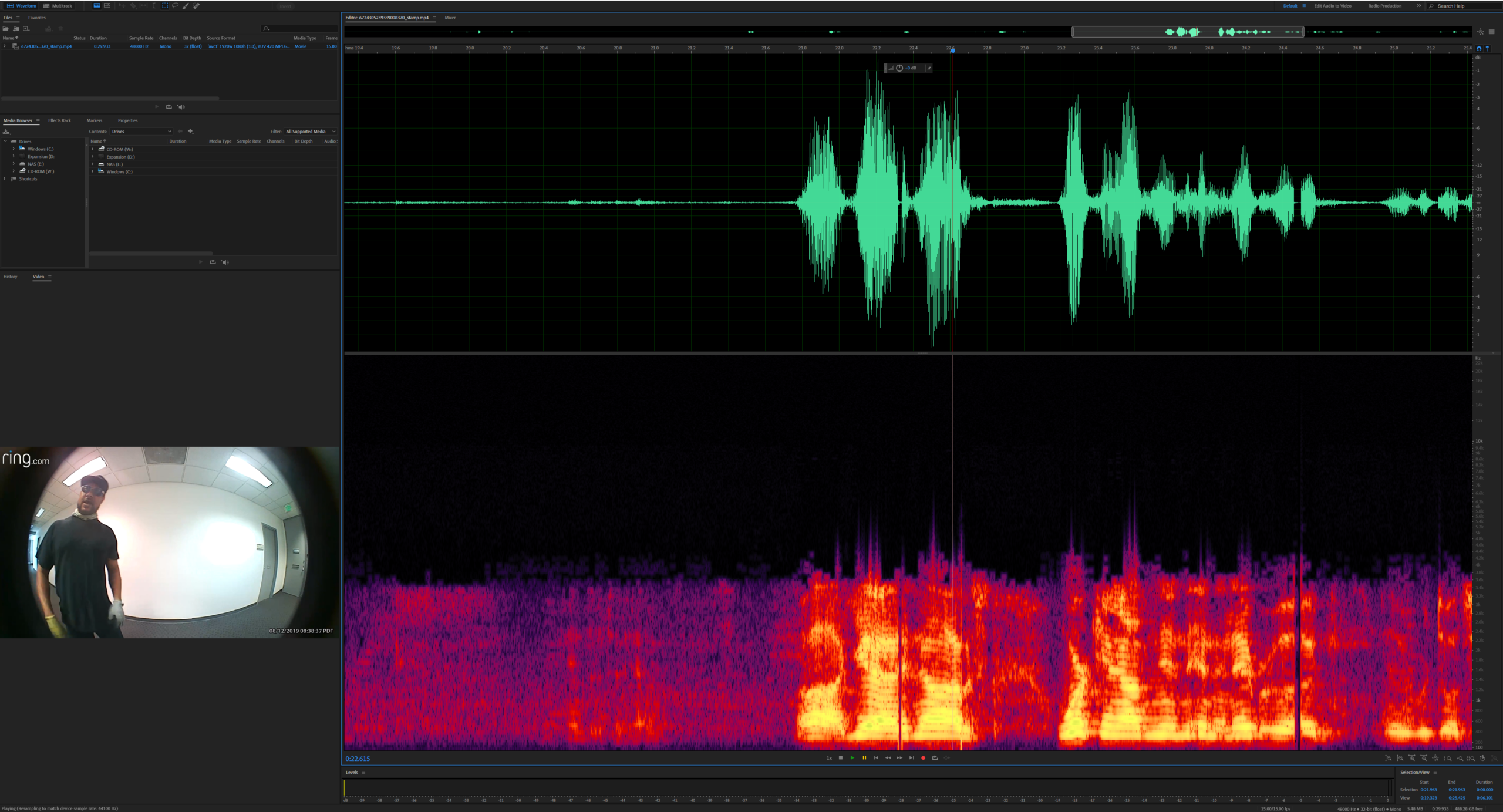
- We can utilize a number of tools and filters to clarify an audio recording better hear what is said or happening, some of these include:
- Voice De-noise: This tool offers real-time, zero-latency dialogue noise reduction and adjustment to correct for shifting background sounds
- De-plosive: A tool designed to eliminate low-frequency plosives (“pops” from the letters b, p, or t) and microphone bumps (“pops” from something coming into physical contact with the microphone)
- De-hum: Removes unwanted hum and radio frequency interference
- Equalizer: An 8-band parametric equalizer used to correct frequency issues in an audio recording
- Mouth De-click: Filters out mouth clicks and similar noises from recordings with speaking and dialogue
- Spectral Repair: Removal of other unwanted noise
An intruder was captured on surveillance video. Here we can see a forensic comparative analysis between the unknown shirt of the intruder (left) and a known shirt (right) recovered during the investigation of the incident. The matching details, circled in yellow, provides strong support that the unknown shirt is a match to the known shirt.
Audio Recording Authentication and Integrity Verification:
- Audio recording authentication is determining if an audio recording is an accurate and fair representation of whatever incident it purports to be
- A careful and thorough analysis of the video and its contents (what is heard in the audio) can be used to confirm its authenticity and relevance to a case
- Integrity verification is an analysis to determine if an audio recording has been changed or altered since it was originally recorded or exported
- Integrity verification can be done by analyzing the audio metadata, by comparing hash values, and by looking for evidence of edits, alterations, or manipulations
- An example would be if the police claim an audio recording has gunfire, but analysis proves the sound is a vehicle backfiring and not gunfire, then the audio recording is not authentic evidence of gunfire
Several enhancement techniques were used to clarify this surveillance video including zooming, tracking, pausing, annotations (yellow arrow), luminance adjustments, trimming, and cropping. Such enhancements allow the viewer to better see what is happening, or perhaps what the subject is holding.
Video Authentication and Integrity Verification:
- Video authentication is determining if a video is an accurate and fair representation of whatever incident it purports to be or show
- A careful and thorough analysis of the video and its contents (what is seen in the video) can be used to confirm its authenticity and relevance to a case
- Integrity verification is an analysis to determine if a video has been changed or altered since it was originally recorded or exported
- Integrity verification can be done by analyzing a video metadata, by comparing hash values, and by looking for evidence of edits, alterations, or manipulations
Photogrammetry:
- Photogrammetry is used to determine measurements of objects or space within a video or image
- Height analysis of a person can be determined by photogrammetry
- The size and dimensions of objects can be determined
- Distance between objects, such as vehicles, can be determined
- Laser Scans and LiDAR can be used to create a 3-Dimensional model of an area or object which can then be used to measure height, size, speed, distance, and more
- Reverse projection photogrammetry is a forensic process of determining whether an unknown object or person in a video is a size, height, or shape match to a known object or person
Using Laser Scanning technology and LiDAR, a 3-Dimensional model can be made of an area. This model can then be used to measure people, objects, distances, and more. This image is a LiDAR scan from the room where an intruder was captured on surveillance video. By placing elements of the surveillance video into the 3D model, we can determine the height of the unknown subject (the intruder).
Our forensic team is ready.
Have audio, video, or phone evidence that needs recovery, analysis, or clarification? Contact our lab to discuss your case with a forensic expert.