

Video Forensics
Forensic Comparative Analysis:
- The process of comparing an unknown object or person to a known object or person
- For instance, is the shirt worn by the subject in the surveillance video the same as the shirt found by police
- This is a comprehensive process of comparing the characteristics of the unknown to known objects
- If enough support is found, an opinion can be made as to whether or not the objects may in fact be one in the same
- This type of forensic analysis can be used to identify people, clothing, vehicles, firearms, faces, and more in a video
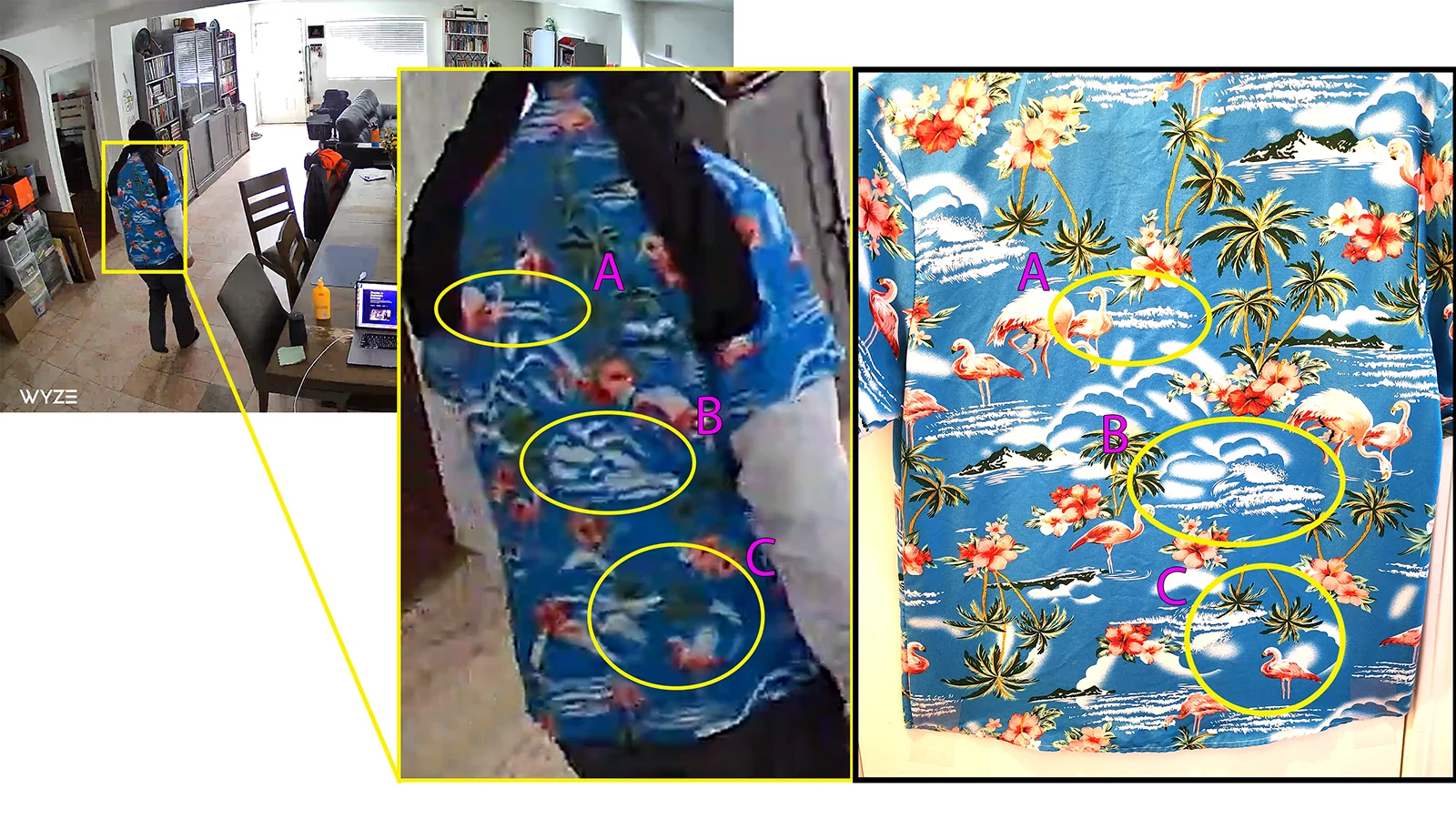
An intruder was captured on surveillance video. Here we can see a forensic comparative analysis between the unknown shirt of the intruder (left) and a known shirt (right) recovered during the investigation of the incident. The matching details, circled in yellow, provides strong support that the unknown shirt is a match to the known shirt.
Video Enhancement and Clarification:
- We use a number of techniques and filters to clarify a video to better see the details of what happened, who was involved, where people and objects are, etc.
- Zooming and cropping is used to focus on a specific person or object and enlarge it to better see the details of who or what it is, or what is happening
- Tracking motion, people, or objects: making a desired person or object the center of the enhanced video’s focus to track its movement throughout the video and better see what is happening with or to that person or object
- Stabilization: taking a video with a lot of movement, such as an officer body-cam video or a hand-held cell phone video, and stabilizing the image so as to remove or significantly reduce movement. Allows us to better see and track what is happening during an incident
- Lighting, color, and contrast corrections: by adjusting the luminance (lighting), colors, contrast, and more we can clarify a video and make details visible that may otherwise not be clear prior to enhancement
Several enhancement techniques were used to clarify this surveillance video including zooming, tracking, pausing, annotations (yellow arrow), luminance adjustments, trimming, and cropping. Such enhancements allow the viewer to better see what is happening, or perhaps what the subject is holding.
Video Authentication and Integrity Verification:
- Video authentication is determining if a video is an accurate and fair representation of whatever incident it purports to be or show
- A careful and thorough analysis of the video and its contents (what is seen in the video) can be used to confirm its authenticity and relevance to a case
- Integrity verification is an analysis to determine if a video has been changed or altered since it was originally recorded or exported
- Integrity verification can be done by analyzing a video metadata, by comparing hash values, and by looking for evidence of edits, alterations, or manipulations
Photogrammetry:
- Photogrammetry is used to determine measurements of objects or space within a video or image
- Height analysis of a person can be determined by photogrammetry
- The size and dimensions of objects can be determined
- Distance between objects, such as vehicles, can be determined
- Laser Scans and LiDAR can be used to create a 3-Dimensional model of an area or object which can then be used to measure height, size, speed, distance, and more
- Reverse projection photogrammetry is a forensic process of determining whether an unknown object or person in a video is a size, height, or shape match to a known object or person
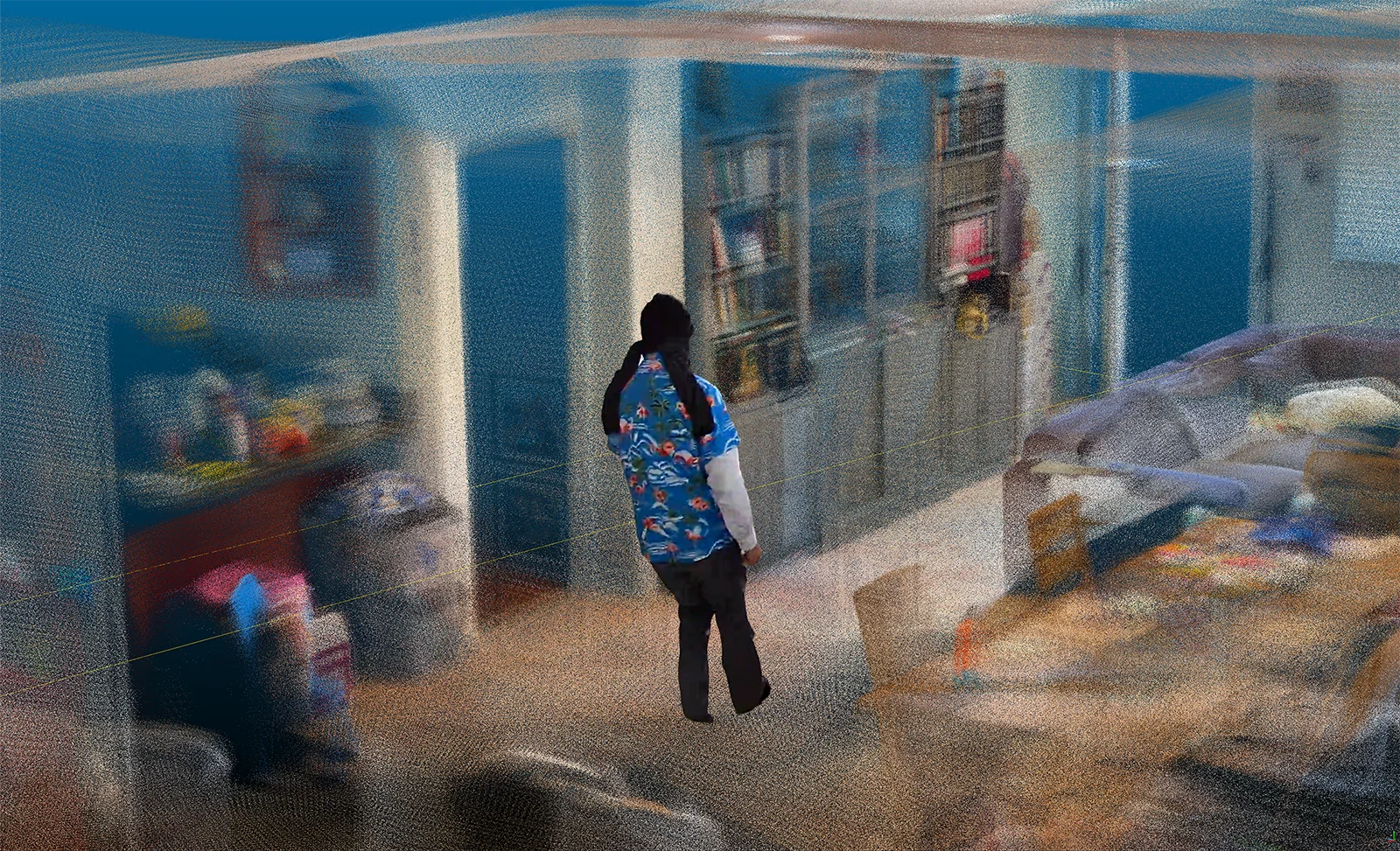
Using Laser Scanning technology and LiDAR, a 3-Dimensional model can be made of an area. This model can then be used to measure people, objects, distances, and more. This image is a LiDAR scan from the room where an intruder was captured on surveillance video. By placing elements of the surveillance video into the 3D model, we can determine the height of the unknown subject (the intruder).
Our forensic team is ready.
Have audio, video, or phone evidence that needs recovery, analysis, or clarification? Contact our lab to discuss your case with a forensic expert.